
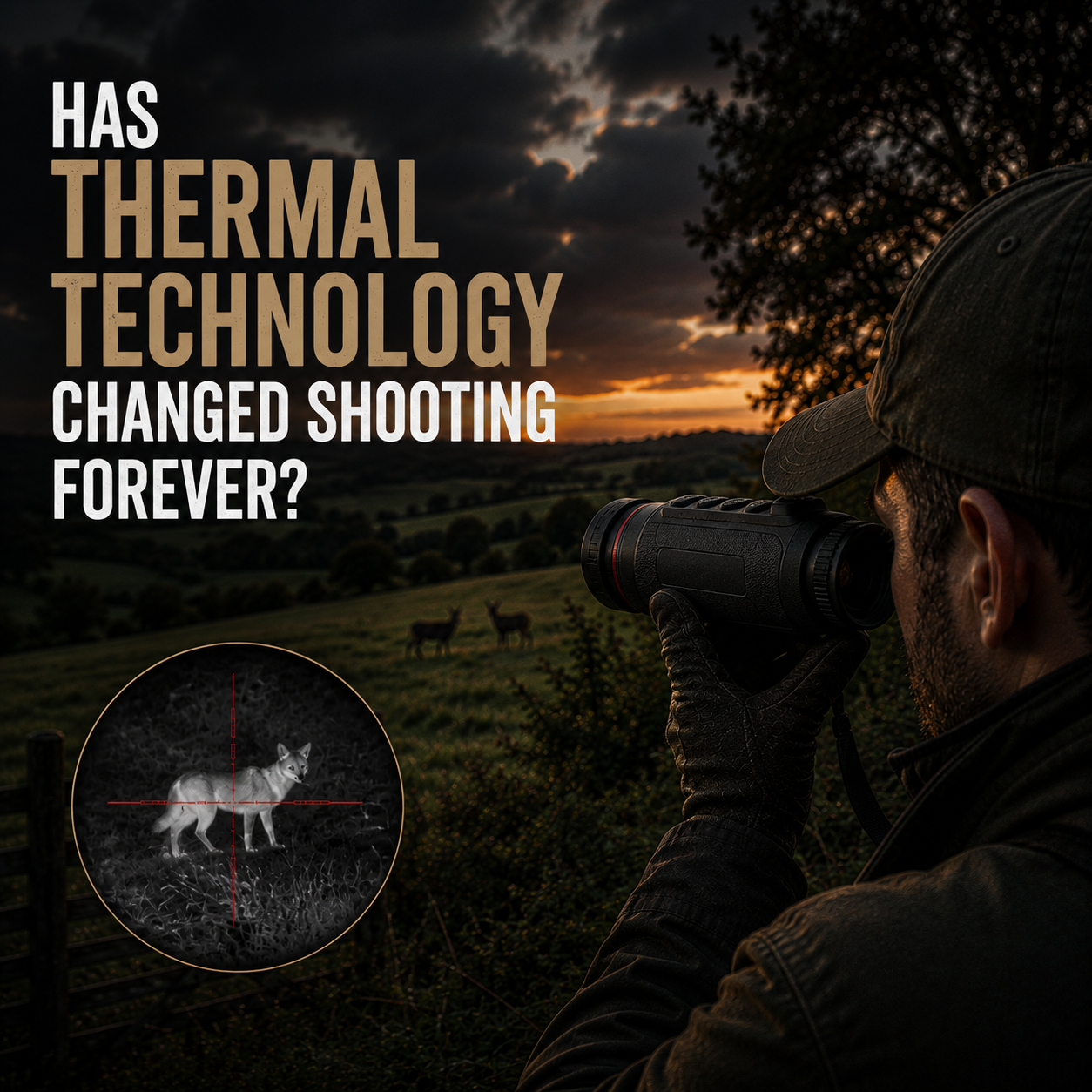
Has Thermal Technology Changed Shooting Forever?
Has Thermal Technology Changed Shooting Forever?
There was a time when successful pest control or foxing relied almost entirely on patience, fieldcraft, and experience.
Knowing where to sit. Understanding wind direction. Reading animal behaviour. Spending countless hours learning your ground. These skills weren't learned overnight, and they certainly couldn't be bought.
Today, however, thermal technology has transformed the way many shooters operate in the field.
The question is: has thermal improved shooting, or is it slowly making traditional fieldcraft obsolete?
The Rise of Thermal
Over the last decade, thermal imaging has gone from specialist military-style equipment to something increasingly common in the shooting world.
What was once expensive, bulky, and out of reach for most shooters is now more accessible than ever. Brands such as Pulsar, HIKMICRO, and NocPix continue to push the technology forward, delivering clearer images, greater detection ranges, and more user-friendly systems year after year.
For pest controllers and professional wildlife managers, thermal has become a game changer.
Animals that would previously remain hidden in darkness can now be detected instantly. Areas can be scanned in seconds rather than hours. Time spent walking fields is reduced, and opportunities that may have been missed altogether are suddenly visible.
There's no denying that thermal technology works.
What Thermal Does Well
The biggest advantage of thermal isn't necessarily shooting.
It's observation.
Being able to identify animal activity before ever switching on a lamp has dramatically improved safety, efficiency, and decision-making in the field.
Foxes can be spotted crossing distant fields. Deer can be monitored without disturbance. Livestock can be checked in darkness. Lost animals can often be located far quicker than before.
For farmers dealing with pest issues, thermal can make a genuine difference.
It's hard to argue against technology that allows problems to be identified more quickly and managed more effectively.
But What About Fieldcraft?
This is where opinions begin to divide.
Many experienced shooters argue that younger generations are becoming increasingly dependent on technology.
Why spend years learning where foxes travel when thermal can show you instantly?
Why learn to read subtle signs in a field when a thermal spotter can reveal everything within seconds?
Some believe valuable countryside skills are at risk of being lost.
Others disagree entirely.
They argue that thermal doesn't replace fieldcraft—it simply enhances it.
After all, spotting an animal is only one part of the equation.
You still need permission to shoot. You still need safe backstops. You still need to understand wind, bullet placement, animal behaviour, and when not to take a shot.
Technology may help find the opportunity, but good judgement is what determines the outcome.
The Human Element
Perhaps the reality sits somewhere in the middle.
The best shooters aren't successful because they own the most expensive equipment.
They're successful because they know how to use it.
A thermal monocular in inexperienced hands won't suddenly create a skilled pest controller. Equally, even the most experienced shooter can benefit from tools that improve safety and efficiency.
Throughout history, shooting has always evolved.
Moderators were once viewed as unusual.
Rangefinders changed long-range shooting.
Ballistic apps replaced handwritten data cards.
Now thermal is changing the game again.
Each advancement sparked debate. Most eventually became accepted.
The Future of Shooting
Thermal technology isn't going away.
In fact, it will almost certainly become more capable, more affordable, and more widely used over the next few years.
The challenge for the shooting community is not deciding whether thermal is good or bad.
The challenge is ensuring traditional skills continue to be passed down alongside modern technology.
Fieldcraft, patience, and understanding the countryside remain just as important today as they were twenty years ago.
The equipment may have changed.
The principles haven't.
Because at the end of the day, the best shooters aren't those with the most technology.
They're the ones who combine modern tools with traditional knowledge to make better decisions in the field.
And perhaps that's where the future of shooting really lies.

Leave a comment
This site is protected by hCaptcha and the hCaptcha Privacy Policy and Terms of Service apply.